Footpaths 101
Because what is a footpath anymore?
On some many days, living in today’s Bangalore can feel absurdly vindictive. Almost deliberately so, where the entire city has conspired that anything that could go wrong, should. The footpaths were the first in line.
A lack of planning, execution and maintenance has turned the car into the first citizen and the pedestrian into an afterthought. A good footpath is a rarity, to the point where a jaded citizen could wonder – what even is a footpath anymore?
Here’s what we should expect from one :

This is informed by the ITDP’s handbook, based on the Indian Road Congress’ standards. The same handbook also reminds us that footpaths can come in different sizes.
Cities have different zones based on activity. So do footpaths. Depending on which part of the city they’re being laid in, each zone of the footpath can have varying minimum widths, as shown here.
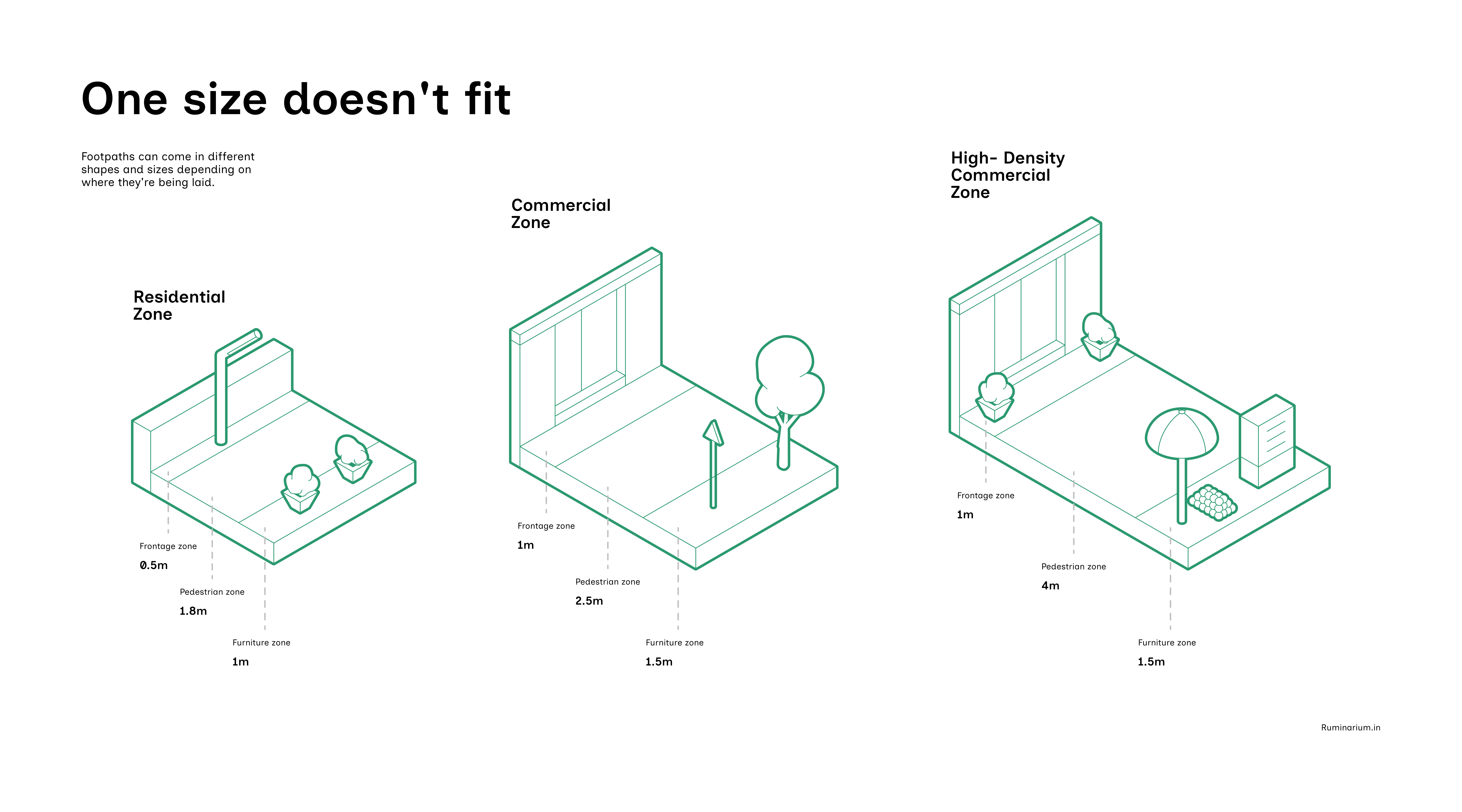
- The frontage zone is the buffer space in front of a private property. It can be used for signage, lighting and display units.
- The pedestrian zone is the main walkway. This should be unobstructed.
- The furniture zone is where we can place other utilities, like benches, trees, utility boxes, trash cans and bus stands.
This needn’t be a distant dream. Even a clean, uninterrupted paved stretch – not the gutter caps we have right now – would be a fresh start.
Bangalore’s civic failures, infrastructure impotence and systemic decay is well known and lived. Citizens have realised as much and spurred a wave of action.
Urban activists like Caleb, Arun Pai and The Ugly Indian are bringing together citizen volunteers and the newly formed GBA to restore and revitalise footpaths.
I think the future of Bangalore will be DIY 🙂↕️